
Washington Loses Canada
New Budget Commits $200B to Break U.S. Ties

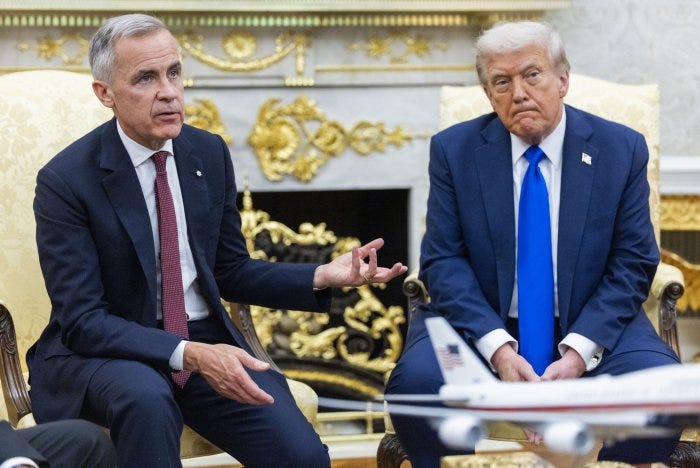
U.S. President Donald Trump’s tariffs and treaty-breaking are costing America its most integrated ally. Canada is redirecting hundreds of billions of dollars toward economic independence.
Canada unveiled a federal budget Tuesday — the day Americans went to the polls — that includes 280 billion Canadian dollars ($200 billion) over five years for infrastructure, military and investments aimed at reducing reliance on U.S. trade, ending decades of deepening economic ties.
The budget frames Canada’s pivot as “shifting from reliance to resilience,” transforming the economy “from one that is overly reliant on a single trading partner, to one that is more resilient to global shocks.”
The spending plan delivers on Prime Minister Mark Carney’s March 27 declaration that “the old relationship we had with the United States, based on deepening integration of our economies and tight security and military cooperation, is over.”
Carney made that statement a day after Trump announced 25 percent tariffs on foreign car imports. Carney warned Canada would need to “dramatically reduce our reliance on the United States.”
Ottawa accused Washington of violating the U.S.-Mexico-Canada Agreement that Trump had negotiated by imposing sector-specific tariffs on goods — including 50 percent on steel and aluminum — that should receive duty-free treatment under the trade pact.
Canada filed World Trade Organization dispute proceedings over the tariffs.
The rupture threatens U.S. access to a market that absorbed $348.4 billion in American exports in 2024. Canada sent about 76 percent of its exports to the United States that year — a level of integration unmatched by any U.S. ally. But that share dropped to 68.3 percent by May, one of the lowest proportions on record, as Trump’s tariffs took effect.
American industries and communities depend heavily on Canadian supply chains, energy and raw materials. So does the U.S. tourism sector, which has seen a plunge in Canadian tourism.
And the tariffs have cost U.S. jobs — automaker Stellantis laid off 900 U.S. hourly workers who make powertrains and stampings that supply Canadian and Mexican plants affected by the tariffs, while steel manufacturer Cleveland-Cliffs laid off more than 1,200 U.S. workers in March, anticipating Trump’s April 2 “Liberation Day“ tariff announcement.
The tariffs are also hitting American farms and rural economies hard.
“Our input costs have gone up dramatically because of tariffs on imports — fertilizer, equipment, steel, aluminum,” Indiana grain farmer Brent Bible told United Press International. “If we need a replacement part or a new tractor, all of those things are impacted. We’re getting squeezed at both ends, and when that happens, there’s nothing left in the middle.”
He said the economic damage extended beyond individual farms.
“It’s had an individual impact, not just on producers, but on communities throughout rural America,” Bible said.
The Canadian budget allocates CA$25 billion ($18 billion) to protect and retool industries hit by U.S. tariffs, including auto manufacturing, steel, aluminum, forestry and agriculture. A new “Buy Canadian” procurement policy will require federal agencies to prioritize domestic suppliers over American companies for government contracts.
Canada also accelerated free trade negotiations with Asian nations during Carney’s weeklong October trip to Malaysia, Singapore and South Korea. The government aims to double Canadian exports to non-U.S. markets over the next decade — growth that would have otherwise gone to American trading partners.
The shift reverses decades of North American integration that began with the 1988 Canada-U.S. Free Trade Agreement and deepened through the North American Free Trade Agreement and its USMCA successor, known in Canada as the Canada-United States-Mexico Agreement, or CUSMA.
Restoring the old relationship is unlikely, writes Alicia Wanless of the Carnegie Endowment for International Peace in Washington. Wanless, who researches how governments manipulate public narratives to influence international relationships, calls the rupture a breakdown in trust.
“Carney was reading the room when he proclaimed that Canada’s relationship with the United States was over,” she writes.
Canada’s budget commits hundreds of billions in concrete investments to build supply chains and trading relationships independent of the United States. Canadian companies that once shipped 90 percent of their exports south are now finding Asian buyers. Federal procurement worth billions annually will now exclude American suppliers.
Carney won his election in April by campaigning explicitly on reducing Canadian ties with an unreliable American partner. The budget fulfills that promise with binding financial commitments.
Even if a future U.S. administration seeks to rebuild the relationship, Canada’s budgetary and trade commitments have already locked in a new trajectory. Ottawa is no longer seeking deeper integration — it’s building insulation.
Great commentary on a sad, distressing, and disheartening state of affairs.